
You Shall Have No Other Gods
The First Commandment and the Authority of AI

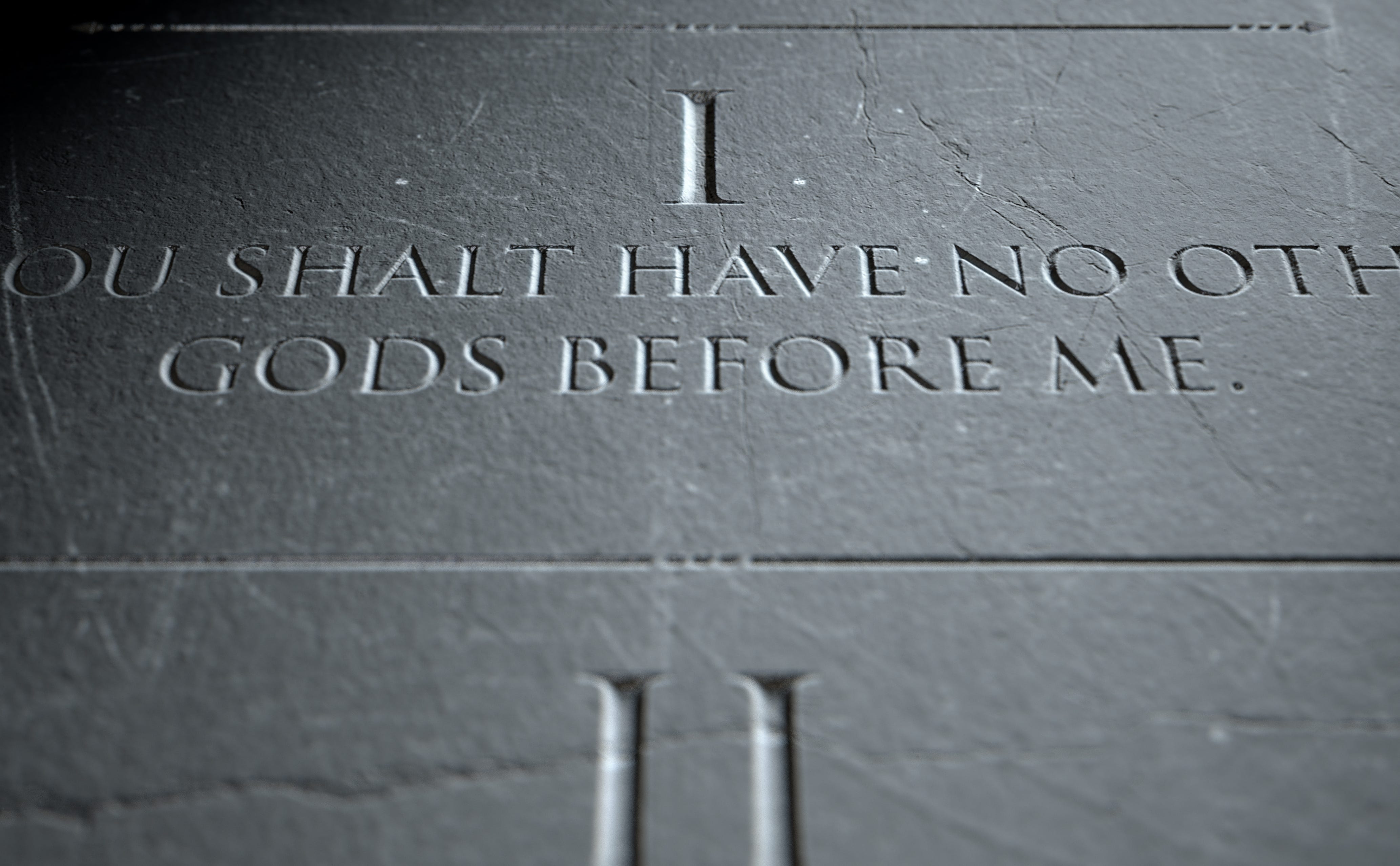
I. The Commandment
“You shall have no other gods before me.” (Exodus 20:3)
The Westminster Shorter Catechism addresses the first commandment in three questions.
Q46. What is required in the first commandment?
The first commandment requireth us to know and acknowledge God to be the only true God, and our God; and to worship and glorify him accordingly.
Q47. What is forbidden in the first commandment?
The first commandment forbiddeth the denying, or not worshipping and glorifying the true God as God, and our God; and the giving of that worship and glory to any other, which is due to him alone.
Q48. What are we specially taught by these words “before me” in the first commandment?
These words “before me” teach us that God, who seeth all things, taketh notice of, and is much displeased with, the sin of having any other God.
II. Biblical Context
The ten commandments open with a preamble, a declaration of who God is and what he did for Israel.
“I am the Lord your God, who brought you out of the land of Egypt, out of the house of slavery.” (Exodus 20:2)
Edmund Clowney observes that the commandments “are written to establish the separate and unique identity of the people with whom God established a covenant agreement.”1 The preamble follows a pattern similar to a suzerain-vassal treaty: the ruling king declares his name and acts, and the vassal is bound exclusively to that king. However, the suzerain who gave this covenant is not simply a king among kings. When Moses asked his name at the burning bush, God responded: “I AM WHO I AM” (Exodus 3:14). YHWH is self-existent. YHWH does not derive his being from anything outside himself. Instead, every created thing exists because YHWH brought it into being.
The context of the commandment begins in Egypt, the most polytheistic civilization in the ancient world. The Egyptians organized life around a pantheon of gods: the Nile, the sun, the harvest, death, and kingship. Every deity had its domain. Pharaoh himself was considered divine. Israel had lived in that world for four hundred years.
God answered Pharaoh’s refusal with a systematic verdict against Egypt’s gods. Moses went before Pharaoh with a single demand: “Let my people go” (Exodus 5:1). When Pharaoh refused, what followed was judgment. Through ten plagues, God dismantled the Egyptian pantheon one domain at a time. YHWH showed, plague by plague, that every god Egypt trusted was no god at all. Israel had watched the gods of Egypt fail.
“You shall have no other gods before me.” (Exodus 20:3)
Though the Israelites had seen YHWH dismantle every god Egypt trusted, they built one of their own, a golden calf. The phrase before me carries the full weight of the commandment. It means before my face, in my presence, under my direct watch. The impulse to rebel against God was as old as the rebellion in the Garden of Eden. Adam and Eve, surrounded by God’s provision, reached for the one thing forbidden, not out of need but out of the desire to be their own authority. At Sinai, Israel did the same. They rebelled against the revealed law of God.
III. Theological Significance
The first commandment corresponds to God’s supremacy. Vern Poythress, in Making Sense of the World, expounds on a framework he calls Lex Christi, the law of Christ.2 It begins with the Decalogue. Each commandment specifies what human beings do to obey God. Each one also reflects an attribute of the God who gave it. The first commandment reflects God’s supremacy. God alone is ultimate. God alone is self-existent. Every other thing that exists derives its being from God and is contingent on him.
God’s supremacy governs not only worship but also extends to his lordship. In his work on the doctrine of God, John Frame identifies three inseparable attributes which together define God’s lordship: authority, control, and presence.3 God’s authority means he alone has the right to speak finally on any matter. His word is the ultimate standard, and no external measure stands above it. God’s control means he governs all things. As demonstrated in Egypt, nothing occurs outside his sovereign direction. God’s presence means he is never absent. He is near to every creature, aware of every thought, engaged during every moment of history. The first commandment is not God staking a claim among rivals. Rather, God is declaring that no rivals exist. To place another creature before God is to deny his lordship.
In the New Testament, God’s supremacy and lordship reach their fullness in Christ. Paul writes that in Christ the fullness of deity dwells bodily, and that Christ is the head of all rule and authority (Col. 2:9-10). The God who declared his supremacy at Sinai took on flesh, bore the curse of the broken law, and rose as Lord over all. Every claim to authority, whether human, institutional, or technological, stands beneath Christ’s headship. The first commandment was fulfilled in Christ.
IV. Ethical Application
In a world of multiplying authorities, to whom do we turn? The first commandment presses the question with urgency in the age of large language models. A professional faces a legal question and asks the machine for guidance. A pastor faces a theological question and asks the machine. A parent poses a medical question to the model. The machine answers fluently and confidently. The answer arrives in seconds, asks nothing, and requires no relationship. For a growing majority, the AI has become a first resort for ultimate authority.
What is AI, exactly? The previous essay in this series responds with a framework to help understand: math, not magic; model, not mind; machine, not image of God. As compelling as an AI response may seem, there is no consciousness behind the output, no covenant standing, no orientation toward truth, and no love. The scientific description is that it is the product of an optimization process encoded in mathematical weights, returning a probability distribution over language. The theological perspective is that, though it is built by engineers in a fallen world with fallen assumptions, it functions within a universe that exists only because God sustains it, subject to his creative order, governed by his laws, and incapable of transcending the creature it is.
In today’s context, the sin the first commandment names is replacing God’s authority with AI’s. Egypt structured its entire civilization around a pantheon of gods, each assigned a specific domain of life, each available to be approached, appeased, or consulted when needed. Generative AI, deployed without theological discipline, reproduces Egypt’s structure. There is a domain for every question and an answer for every need. It draws on a dataset of a fallen world, formed by assumptions that do not begin with the fear of the Lord (Prov. 9:10). Without theological and ethical guardrails, AI stands to usurp the authority, control, and presence that belong to God alone.
The creation mandate calls God’s people to cultivate, build, and develop — to exercise dominion over creation with skill and wisdom. AI is a technology in that service. Use it to accelerate medical research, assist with engineering designs, manage crops, and evaluate complex data. That is a legitimate gift of God’s common grace. Rightly ordered, AI serves the mandate. Wrongly ordered, it has the potential to become an idol. The moment it displaces God’s lordship and becomes the first resort for truth, the final word on ethics, or the theological authority consulted before Scripture, it violates the first commandment.
The apostle John reminds us, “For the law was given through Moses; grace and truth came through Jesus Christ” (John 1:17). Those who have been redeemed have the motive, the means, and the capacity to wield AI as a tool rather than bow to it as a god.
Clowney, Edmund P. How Jesus Transforms the Ten Commandments. P&R Publishing, 2007. p. 2
Poythress, Vern S. Making Sense of the World. P&R Publishing, 2022. pp. 127–133.
Frame, John M. Theology in Three Dimensions. P&R Publishing, 2019.7. p. 1